

Avalanche Subnets vs Ethereum Rollups: Scalability Comparison for Institutional DeFi 2026

In the high-stakes arena of institutional DeFi by 2026, scalability isn’t just a buzzword; it’s the foundation of sovereign control and cost efficiency. Enterprises deploying blockchain infrastructure face a pivotal choice: Avalanche’s subnets, which empower custom, parallel chains with over 4,500 transactions per second and sub-second finality, or Ethereum’s rollups, now handling 60% of transactions via Layer 2 solutions amid slashed gas fees averaging $1.60. As a seasoned investor with 18 years in macro finance, I’ve watched protocols evolve, and patience indeed pays in their maturation. This comparison dissects how these architectures serve forward-thinking organizations chasing enterprise DeFi scalability.

Avalanche Technical Analysis Chart
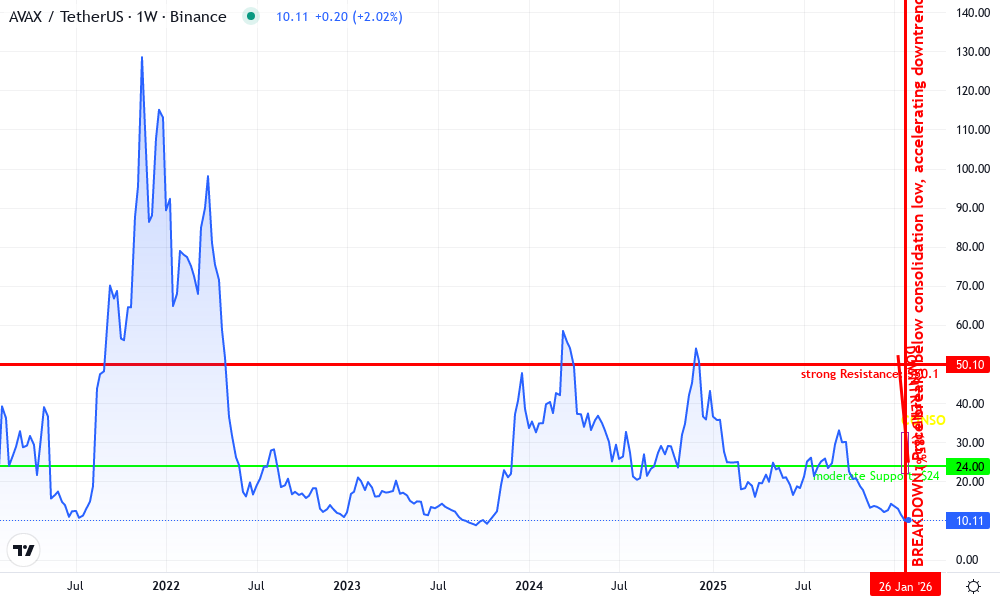
Analysis by Robert Patel | Symbol: BINANCE:AVAXUSDT | Interval: 1W | Drawings: 5
Technical Analysis Summary
As Robert Patel, my conservative drawing approach emphasizes clear support/resistance horizontals, a primary downtrend line from recent 2026 highs, and rectangles for consolidation zones to highlight risk without over-speculating. 1. Draw a ‘downtrend’ trend_line from 2026-01-15T00:00:00Z at 52.30 to 2026-02-04T00:00:00Z at 24.80, extending right for projection. 2. Add horizontal_lines at key support 20.50 (weak) and resistance 35.20 (moderate), 50.10 (strong). 3. Use rectangle for recent consolidation from 2026-01-20T00:00:00Z-2026-02-04T00:00:00Z between 22.00-32.50. 4. Place arrow_mark_down at MACD bearish cross near 2026-01-28T00:00:00Z. 5. Callout on declining volume post-2026-01-15T00:00:00Z. 6. Vertical_line at potential breakdown 2026-02-01T00:00:00Z. Keep minimal to avoid clutter, focusing on risk containment.
Risk Assessment: high
Analysis: Extreme volatility from 144 peak to 24.80 lows defies low-risk compounding; crypto lacks dividend stability amid competition from Ethereum rollups.
Robert Patel’s Recommendation: Avoid new positions; hold cash or pivot to ESG dividend stocks for resilient growth.
Key Support & Resistance Levels
📈 Support Levels:
-
$20.5 – Visual cluster low near 2026 Feb open, potential bounce if volume picks up.
weak -
$24 – Immediate support aligning with recent lows.
moderate
📉 Resistance Levels:
-
$35.2 – Short-term overhead from Jan consolidation.
weak -
$50.1 – Strong resistance at 2026 Jan highs.
strong
Trading Zones (low risk tolerance)
🎯 Entry Zones:
-
$50.1 – Only conservative long entry above strong resistance confirmation with volume, aligning low-risk tolerance.
low risk
🚪 Exit Zones:
-
$20 – Tight stop below key support to limit downside.
🛡️ stop loss -
$60 – Modest profit target based on prior swing high projection, emphasizing capital preservation.
💰 profit target
Technical Indicators Analysis
📊 Volume Analysis:
Pattern: declining
Volume (TX) spikes with price but fading on downside, lacking conviction for reversal.
📈 MACD Analysis:
Signal: bearish crossover
MACD line below signal with histogram contracting negative, confirming downtrend momentum.
Applied TradingView Drawing Utilities
This chart analysis utilizes the following professional drawing tools:
Disclaimer: This technical analysis by Robert Patel is for educational purposes only and should not be considered as financial advice.
Trading involves risk, and you should always do your own research before making investment decisions.
Past performance does not guarantee future results. The analysis reflects the author’s personal methodology and risk tolerance (low).
Avalanche Subnets: Tailored Sovereignty for Institutional Workloads
Avalanche’s subnet architecture stands out for its modularity, allowing enterprises to spin up app-specific blockchains that operate independently yet harmonize within the primary network. By Q3 2025, over 100 active subnets had emerged, spanning gaming, finance, and tokenization use cases. This isn’t mere hype; Avalanche’s DeFi total value locked hit $2.77 billion by mid-2025, up 53% quarter-over-quarter, fueled by 146,579 daily active addresses and 18.5 million daily transactions. Institutions value the deterministic finality and EVM compatibility, which enable seamless migration of Ethereum tools while isolating workloads to prevent congestion spillover.
Strategically, subnets align with custom subnet tokenomics, letting enterprises define governance, fees, and validators tailored to their risk profiles. Unlike monolithic chains, this parallelism crushes bottlenecks, delivering sub-second confirmations ideal for high-frequency trading or real-time settlements in DeFi protocols. Boston University’s analysis crowns Avalanche as the fastest-growing in enterprise subnets, underscoring its edge in technical depth over consensus mechanisms like Ethereum’s Casper FFG, which relies on checkpoints.
| Metric | Avalanche Subnets | Ethereum Rollups |
|---|---|---|
| TPS | and gt;4,500 | Batch-dependent (L2: 100s-1000s) |
| Finality | Sub-second | ~12-15 min (L1 settlement) |
| Customization | Full sovereignty | L1 anchored |
| TVL (2025) | $2.77B | L2 dominant |
From an investor’s lens, this isolation mitigates systemic risks, a boon for institutions wary of shared-state vulnerabilities. Subnetsfor. com exemplifies this, offering scalable, secure setups that reduce costs and boost performance on Avalanche.
Ethereum Rollups: Ecosystem Depth Meets Layered Efficiency
Ethereum’s path to scalability pivots on rollups – optimistic and zk varieties that batch transactions off-mainnet, settling proofs on Layer 1 for ironclad security. The 2025 proto-danksharding via EIP-4844 slashed average gas fees 72%, from $5.80 to $1.60 per transaction, unlocking viability for institutional volumes. By December 2025, daily active addresses climbed 45% year-over-year to 1.2 million, with Arbitrum and Optimism absorbing 60% of Ethereum’s transaction load.
This L2 dominance crafts a specialized cloud-like region, as Dr. Ravi Chamria notes, with Ethereum as the unassailable settlement layer. Rollups inherit Ethereum’s battle-tested security and vast DeFi liquidity, proven by its mature ecosystem. Yet, for L1 vs L2 institutional plays, the dependency on mainnet finality introduces latency – often minutes – contrasting Avalanche’s instantaneity. Sources like Komodo Platform highlight Ethereum’s depth against Avalanche’s speed and modularity.
Decoding Throughput and Cost Dynamics in DeFi Contexts
When pitting Avalanche subnets vs Ethereum rollups, throughput reveals stark divergences. Subnets’ parallel execution yields consistent high TPS without L1 bottlenecks, suiting enterprise apps demanding uninterrupted flows. Rollups excel in cost compression through batching, but peak Ethereum congestion can still inflate L2 fees indirectly. LCX emphasizes subnets’ strengths in isolation and EVM parity, while OKX lauds their developer autonomy over rollups’ L1 tethering.
For institutions, the calculus hinges on sovereignty versus composability. Subnets grant full control over chain parameters, fostering bespoke DeFi primitives, whereas rollups leverage Ethereum’s interoperability for seamless asset bridging. Chainstack’s 2026 RPC guide flags Avalanche’s enterprise readiness, with providers optimizing subnet performance.
Enterprises must weigh these trade-offs against their DeFi ambitions. Custom subnet tokenomics, for instance, permit institutions to embed native incentives aligned with proprietary strategies, unencumbered by Ethereum’s generalized fee market. This sovereignty appeals to sectors like tokenized real-world assets, where regulatory silos demand isolated execution environments. Conversely, rollups shine in composable DeFi hubs, where atomic swaps across protocols amplify liquidity – a gravitational pull for hedge funds and market makers.
6-Month Price Performance: AVAX vs ETH Rollups and Key Competitors
Real-time cryptocurrency price comparison amid market decline (as of 2026-02-04), highlighting AVAX against Ethereum and scalability rivals
| Asset | Current Price | 6 Months Ago | Price Change |
|---|---|---|---|
| AVAX | $10.09 | $14.00 | -27.9% |
| ETH | $2,270.90 | $2,978.77 | -23.8% |
| ARB | $0.1339 | $0.1371 | -2.4% |
| OP | $0.2225 | $0.2310 | -3.6% |
| MATIC | $0.1339 | $0.1400 | -4.4% |
| SOL | $97.79 | $125.07 | -21.8% |
| DOT | $1.52 | $2.14 | -29.0% |
| NEAR | $1.19 | $1.71 | -30.4% |
Analysis Summary
Over the past six months, AVAX has declined 27.9%, underperforming ETH’s 23.8% drop. Ethereum L2 tokens like ARB, OP, and MATIC show milder losses (2.4%-4.4%), while other L1s such as DOT and NEAR fell over 29%, reflecting broader market downturn.
Key Insights
- AVAX down 27.9%, steeper than ETH’s -23.8% amid scalability competition
- Ethereum rollup tokens resilient: ARB (-2.4%), OP (-3.6%), MATIC (-4.4%)
- L1 peers SOL (-21.8%), DOT (-29.0%), NEAR (-30.4%) also declined significantly
- Market-wide bearish trend impacts all assets despite institutional DeFi growth prospects
Real-time data from Yahoo Finance (it.finance.yahoo.com/quote/*-USD/). 6-month changes from ~2025-08-08 to 2026-02-04T05:08:36Z. Prices in USD; percentages as provided.
Data Sources:
- Main Asset: https://it.finance.yahoo.com/quote/AVAX-USD/
- Ethereum: https://it.finance.yahoo.com/quote/ETH-USD/
- Solana: https://it.finance.yahoo.com/quote/SOL-USD/
- Polygon: https://it.finance.yahoo.com/quote/MATIC-USD/
- Arbitrum: https://it.finance.yahoo.com/quote/ARB-USD/
- Optimism: https://it.finance.yahoo.com/quote/OP-USD/
- Polkadot: https://it.finance.yahoo.com/quote/DOT-USD/
- NEAR Protocol: https://it.finance.yahoo.com/quote/NEAR-USD/
Disclaimer: Cryptocurrency prices are highly volatile and subject to market fluctuations. The data presented is for informational purposes only and should not be considered as investment advice. Always do your own research before making investment decisions.
Institutional DeFi Risks & Advantages Comparison Table
| Aspect | Avalanche Subnets | Ethereum Rollups | Winner for Institutions |
|---|---|---|---|
| Contagion Risks | Isolation limits spread 🛡️ | Inherits L1 risks 🔄 | Subnets 🛡️ |
| Validator/Sequencer Centralization | Nascent validators ⚠️ | Sequencer risks ⚠️ | Ethereum ⚖️ |
| Data Availability & Finality | Deterministic finality ✅ | Post-EIP-4844 challenges & probabilistic pitfalls 📈 | Subnets ✅ |
| Interoperability | Warp messaging safe 🚀 | Bridge exploits vulnerable 💥 | Subnets 🚀 |
| Use Case Flexibility | Modular subnets (100+)/HFT/TVL >$2.77 billion/4500+ TPS/fees <$0.01/146,579 daily active addresses 💹 | L2 fragmentation 50+ rollups/fees $1.60/1.2 million daily active addresses/60% tx on L2s 📊 | Subnets 💹 |
Cost dynamics further tilt the scales. Avalanche’s subnet fees, often fractions of a cent, eclipse even Ethereum’s optimized $1.60 L2 averages during volatility spikes. Bleap’s low-fee blockchain ranking omits Avalanche, an oversight given its subnet flexibility, while Polygon and others lag in sovereignty.
Strategic Roadmap: Choosing Your Scalability Path
For institutions eyeing 2026 DeFi dominance, the verdict distills to control versus connectivity. Prioritize subnets if bespoke infrastructure underpins your edge – think sovereign funds tokenizing private equity with custom validators. Opt for rollups when Ethereum’s liquidity moat is paramount, as in yield farming aggregators thriving on shared state.
My philosophy holds: patience pays in protocol evolution. Avalanche’s subnet momentum, with over 100 active chains, signals maturation poised to capture enterprise mindshare. Ethereum’s rollup ecosystem, battle-hardened yet layered, endures as the composability kingpin. Hybrid approaches loom, blending subnet sovereignty with Ethereum bridges, but for now, alignment with core competencies dictates the play.
Organizations partnering with platforms like Subnetsfor. com gain tailored Avalanche deployments, slashing deployment timelines and operational overhead. As macro tailwinds favor efficient blockchains, those betting on modular architectures position for outsized returns in the institutional DeFi surge.