
Zero trust networking 2026 budget
Why Zero Trust is Dead works best when the purchase path is explicit. Verify the source, compare the offer against real alternatives, check the total cost, and confirm what happens after payment before you decide. After each comparison, write down the one risk that would change your mind. If the seller, condition, support, warranty, shipping, or upkeep still feels uncertain, resolve that question before moving to checkout.
The simplest way to use this section is to verify the seller, compare the total cost, and resolve the biggest risk before you commit.
Compare the strongest zero trust networking 2026 options
Zero trust has shifted from a buzzword to a baseline requirement for modern infrastructure. By 2026, the focus has moved beyond simple perimeter defense to identity-first access, continuous verification, and least-privilege enforcement. Choosing the right solution depends on whether you prioritize cloud-native scalability, on-premise visibility, or unified identity management.
The market offers distinct approaches to implementing zero trust. Some vendors focus on network access control (NAC) integration, while others lead with identity and access management (IAM). Below is a comparison of the most robust options available, focusing on architecture, deployment complexity, and core capabilities.
| Vendor | Primary Focus | Deployment Model | Key Strength |
|---|---|---|---|
| Zscaler | Cloud-First ZTNA | SaaS | Seamless cloud integration and strong threat intelligence |
| Cisco Secure | Integrated NAC & ZTNA | Hybrid | Deep visibility into wired and wireless networks |
| Okta | Identity-Centric Access | Cloud/SaaS | Unified identity governance and MFA integration |
| CrowdStrike | Endpoint-Centric Zero Trust | Cloud/SaaS | Real-time endpoint detection and response (EDR) |
Zscaler remains a leader for organizations heavily invested in cloud applications. Its cloud-native architecture simplifies deployment by eliminating the need for on-premise hardware. The primary strength lies in its ability to inspect traffic directly from the cloud, reducing latency and improving security posture for remote workers.
Cisco Secure offers a compelling option for enterprises with significant on-premise infrastructure. By bridging traditional network access control with zero trust principles, Cisco provides deep visibility into both wired and wireless networks. This makes it ideal for organizations transitioning from legacy perimeter security to identity-based access.
Okta focuses on the identity layer, which is the new security perimeter. Its solution excels in managing user identities across hybrid environments, offering robust multi-factor authentication (MFA) and single sign-on (SSO) capabilities. For companies where identity is the primary attack vector, Okta provides a streamlined governance framework.
CrowdStrike leverages its dominance in endpoint detection and response (EDR) to build a zero trust model centered on the device. By continuously verifying endpoint health and user behavior, CrowdStrike ensures that only trusted devices and users can access resources. This approach is particularly effective for protecting sensitive data on mobile and remote devices.
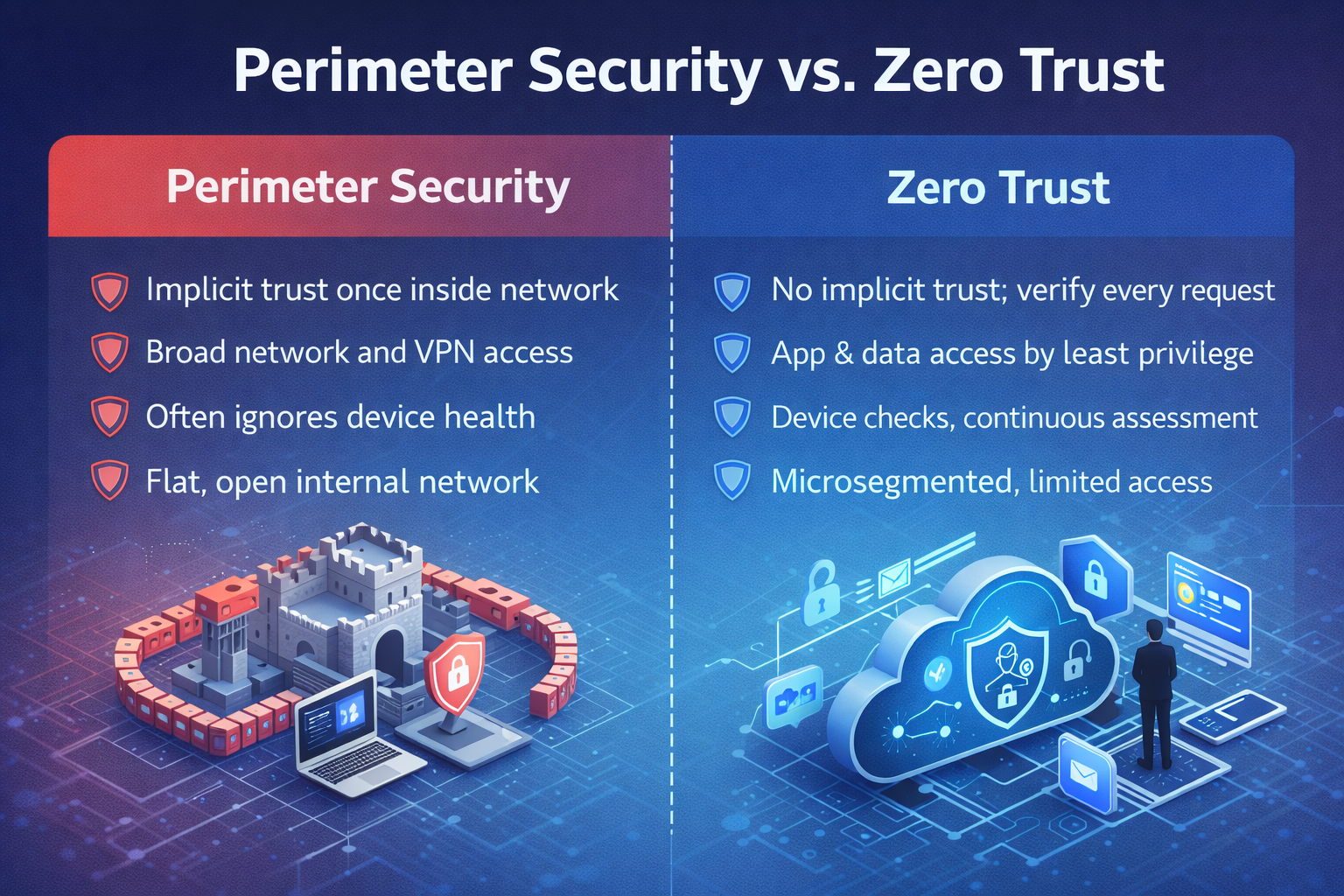
When selecting a zero trust solution, consider your existing infrastructure. Cloud-first organizations may prefer Zscaler or Okta, while those with complex hybrid environments might lean toward Cisco Secure. Endpoint-centric approaches like CrowdStrike are best for organizations prioritizing device security over network architecture.


As an Amazon Associate, we may earn from qualifying purchases.
Inspect the expensive parts
Zero trust is not a product you buy; it is a posture you build. When budgets tighten, the first thing to fall apart is the verification layer. A broken identity chain is far more expensive to fix than a missing firewall rule. Use this checklist to audit your current implementation before scaling.
Check your SSO and MFA integration. If a single identity provider goes down, your entire access model collapses. Ensure you have fallback methods for critical users. Verify that conditional access policies are not overly broad, which defeats the purpose of least privilege.
Look for lateral movement risks. Are your internal services truly isolated? If a compromised endpoint can talk to your database without explicit policy checks, your segmentation is failing. Test this with internal penetration tools to find blind spots.
Zero trust requires knowing the device before the user. Ensure your EDR and MDM solutions are reporting health status in real time. A device with outdated patches should be blocked from accessing sensitive resources, not just flagged for later remediation.
Visibility is your only defense after the perimeter. If your logs are not centralized, you are flying blind. Check for delayed ingestion or gaps in logging for cloud applications. Real-time alerting on impossible travel or unusual data exfiltration is non-negotiable.
Recommended zero trust tools
Building this model requires specific software components. The following tools are commonly used to enforce the pillars of zero trust. Note that prices and ratings are subject to change and should be verified at purchase.
As an Amazon Associate, we may earn from qualifying purchases.
Ownership costs and hidden maintenance surprises
A zero trust architecture is rarely a one-time purchase. The initial license fee is often just the entry ticket. Real costs accumulate through integration labor, ongoing identity management, and the operational overhead of monitoring continuous verification logs. Organizations frequently underestimate how much internal engineering time is required to map legacy systems to modern zero trust policies.
Maintenance surprises often appear when device compliance checks begin failing across large fleets. Every endpoint that falls out of compliance requires manual intervention or automated remediation workflows. This friction can slow down employee productivity, leading to shadow IT as users seek workarounds that bypass security gates. The "cheap" solution often becomes expensive when you factor in the lost hours of IT staff troubleshooting access denials.
When a low-cost solution stops being cheap, it is usually because it lacks native integrations with your existing identity provider or endpoint management platform. You end up paying for third-party middleware or custom scripts to bridge the gaps. Evaluate total cost of ownership (TCO) over three years, not just the first year. Look for solutions that reduce operational friction rather than just adding another tool to your stack.


As an Amazon Associate, we may earn from qualifying purchases.
Zero trust networking 2026: what to check next
Zero trust has shifted from a buzzword to a mandatory baseline for enterprise security. As 2026 progresses, the focus moves beyond theory to practical implementation, identity verification, and tool selection. Below are the most common questions from IT leaders navigating this transition.
What are the 5 pillars of zero trust?
Most modern frameworks converge on five core pillars: identity verification, device health, network segmentation, data protection, and continuous monitoring. Each pillar must operate independently yet share context. If one fails, the others compensate. This layered approach ensures that no single point of failure compromises the entire security posture.
Can ZTNA replace NAC?
Zero Trust Network Access (ZTNA) and Network Access Control (NAC) serve different purposes but often overlap. NAC focuses on physical or logical network entry points, verifying devices before they connect. ZTNA focuses on application-level access, verifying users and context before granting app access. In many 2026 architectures, ZTNA complements rather than replaces NAC, especially for IoT and legacy devices that cannot support modern identity protocols.
What's the best company for zero trust solutions?
There is no single "best" vendor; the right choice depends on your existing stack. Microsoft offers strong integration for Office 365 environments. Zscaler excels in cloud-first, SASE-based deployments. Cisco provides robust on-premises and hybrid options. Evaluate based on your current infrastructure, not just feature lists. The goal is seamless integration, not another siloed tool.
What are the 7 pillars of zero trust?
Some frameworks expand the core five to seven pillars, adding microsegmentation and automated response. Microsegmentation limits lateral movement within the network. Automated response enables real-time remediation without human intervention. These additions address advanced threats that exploit internal network trust. However, the foundational five remain essential; the extra pillars are enhancements, not replacements.
No comments yet. Be the first to share your thoughts!