
Start with identity verification
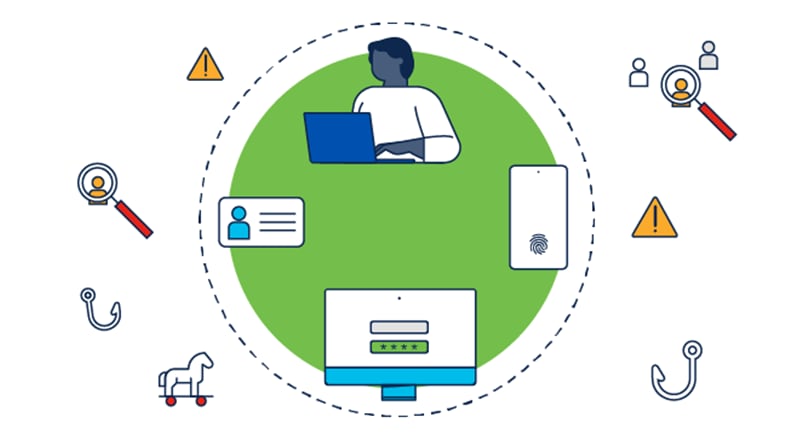
Zero Trust Architecture (ZTA) fundamentally changes the security model by treating identity as the new perimeter. In legacy networks, trust was granted based on network location; if you were inside the firewall, you were trusted. Modern threats bypass these boundaries through compromised credentials, making location-based trust obsolete. You must shift to a "never trust, always verify" stance, where every access request is authenticated and authorized regardless of where it originates.
This verification process relies on strict identity checks before any network access is granted. It requires moving beyond simple username and password combinations to include Multi-Factor Authentication (MFA) and continuous validation. By verifying the user, device, and application context for every request, you eliminate implicit trust. This approach ensures that even if an attacker gains a foothold, they cannot move laterally without re-authenticating at each step.
To implement this, you must integrate identity providers with your network access controls. This involves mapping user roles to specific resources and enforcing least-privilege access. For example, a developer should only access the development environment, not the production database, unless explicitly authorized for a specific task. This granular control reduces the attack surface and limits the impact of any potential breach.
The 2026 implementation landscape emphasizes automated identity governance. Tools that continuously monitor user behavior and device health can dynamically adjust access levels. If a device shows signs of compromise or a user's behavior becomes anomalous, access can be revoked or restricted in real-time. This proactive approach ensures that trust is not static but is constantly re-evaluated based on current risk factors.
By prioritizing identity verification, you lay the foundation for a robust Zero Trust Architecture. It shifts the focus from protecting the network boundary to protecting the data and resources themselves. This strategy aligns with modern security frameworks like NIST SP 800-207, which emphasize the importance of identity-centric security in a distributed and cloud-first world.
Map your enterprise subnets
Before you can enforce zero trust, you must know what traffic is moving through your network. In 2026, legacy perimeter defenses are insufficient because lateral movement often begins inside the enterprise subnet. You need a complete inventory of your subnets to understand the flow of data between identities, devices, and workloads.
Start by running active discovery tools to identify all active IP ranges, VLANs, and cloud VPCs. Map the communication paths between these segments. Look for unexpected flows, such as a developer workstation directly accessing a production database. These anomalies are your entry points for segmentation.
Pre-mapping checklist
-
Run network discovery scans across all on-premise and cloud environments
-
Document all active subnets and their associated VLANs
-
Map traffic flows between critical assets and external endpoints
-
Identify any legacy systems that cannot support modern authentication protocols
-
Verify identity sources (AD, LDAP, SSO) are linked to each subnet
Once you have this map, you can begin applying micro-segmentation policies. Zero trust relies on verifying every request, regardless of where it originates. By understanding your subnet topology, you can place identity verification points at the right locations to block lateral movement before it spreads.
Apply dynamic micro-segmentation
Static VLANs are no longer sufficient for modern enterprise security. In 2026, attackers move laterally through network segments faster than perimeter defenses can react. Micro-segmentation isolates workloads at the identity level, ensuring that a compromised virtual machine cannot pivot to adjacent systems. This approach shifts the security boundary from the network layer to the application layer.
Dynamic micro-segmentation enforces policies based on real-time identity and context rather than IP addresses. When a workload’s identity changes or its behavior becomes anomalous, access controls update automatically. This granularity reduces the attack surface significantly, limiting the blast radius of any breach to a single container or pod.
To implement this effectively, follow these steps to configure your segmentation policies.

Before applying restrictions, you must understand the communication patterns of your environment. Use network visibility tools to create a baseline of east-west traffic. Identify which microservices talk to databases, APIs, and authentication servers. This map reveals critical dependencies that must remain accessible while blocking all other lateral movement.
Replace IP-based rules with identity-centric policies. Assign unique identities to each workload, user, and device. Define least-privilege access rules that specify exactly who can talk to whom. For example, a web server should only be allowed to send traffic to the database port on the backend, and only during specific operational windows. This ensures that even if an attacker compromises a credential, they cannot access unrelated resources.
Implement the enforcement points. For cloud-native environments, use service mesh sidecars or container runtime policies to enforce segmentation. In virtualized data centers, leverage hypervisor-level micro-segmentation features. These agents inspect traffic in real-time, applying the identity-based policies defined in the previous step. Ensure these controls are distributed and do not create a single point of failure.
Micro-segmentation is not a set-and-forget solution. Continuously monitor traffic flows against your policies. Look for blocked legitimate traffic that indicates policy misconfiguration, or unmonitored traffic that suggests a blind spot. Adjust rules dynamically as workloads scale or change. Regular audits ensure that your segmentation remains effective against evolving threats and business needs.
By following these steps, you move beyond static network boundaries. This dynamic approach ensures that security keeps pace with the fluid nature of modern IT infrastructure, providing resilience against both internal and external threats.
Integrate cloud-native controls
Extending zero trust to hybrid and multi-cloud environments requires moving beyond perimeter-based assumptions. In 2026, the focus shifts to identity-centric controls that function uniformly across AWS, Azure, and on-premise infrastructure. This integration ensures that security policies follow the user and workload, regardless of where they reside.
The core mechanism involves deploying Zero Trust Network Access (ZTNA) and Secure Access Service Edge (SASE) solutions that abstract the underlying network complexity. Instead of relying on static IP whitelisting, these controls verify every request based on identity, device health, and context. This approach minimizes the attack surface by enforcing least-privilege access at the application layer rather than the network layer.
To visualize the operational differences between traditional and modern approaches, consider the following comparison:
| Control Point | Legacy Perimeter | Cloud-Native Zero Trust | 2026 Benefit |
|---|
No comments yet. Be the first to share your thoughts!