
Shift from perimeter to identity
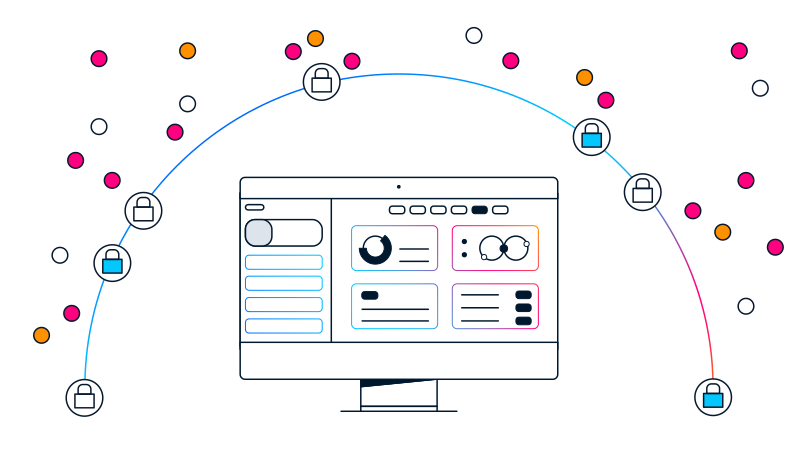
The traditional security model relied on a hardened network perimeter. Firewalls and VPNs created a trusted inner circle, assuming that anything inside the boundary was safe. This "castle-and-moat" approach no longer works. Modern enterprises operate across on-premises data centers, private clouds, and public cloud environments, creating a fluid attack surface where network location is no longer a reliable proxy for trust.
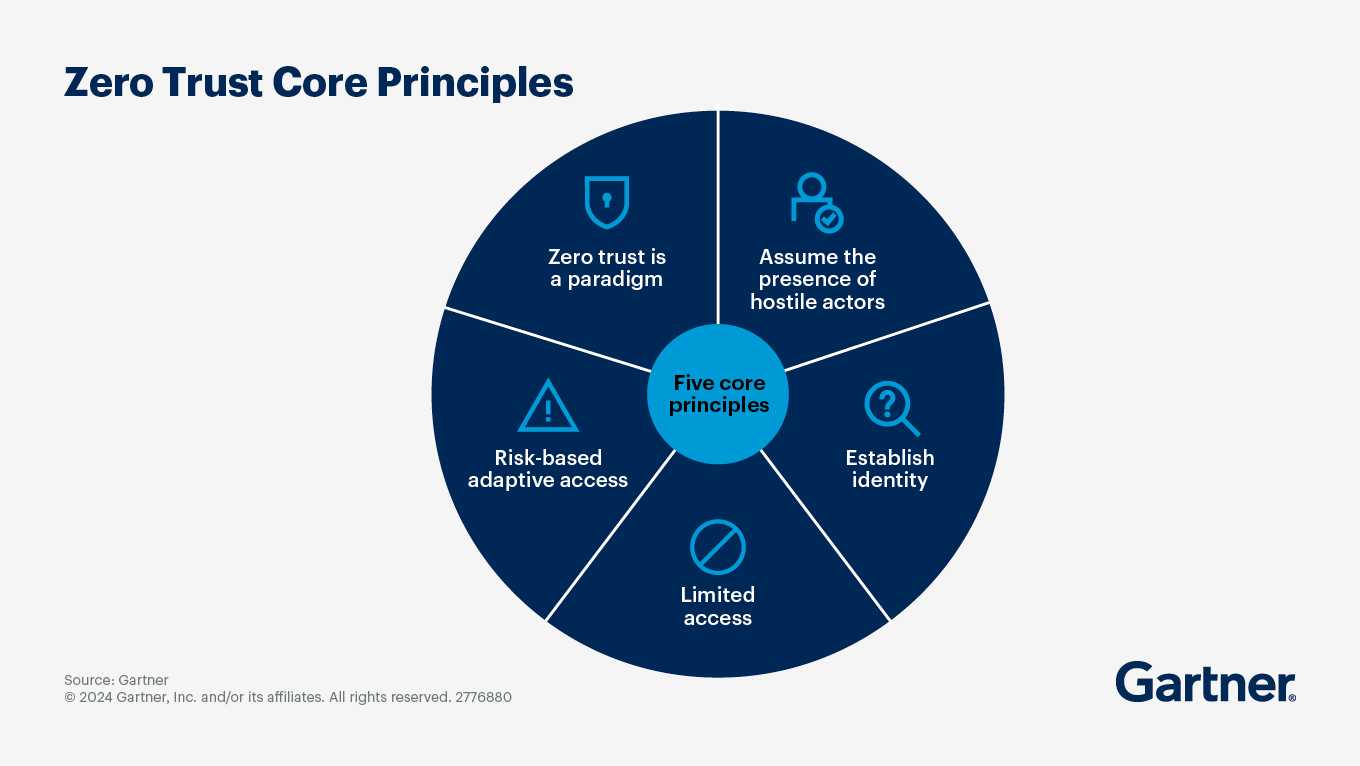
Zero Trust Architecture (ZTA) replaces network-based trust with identity-based trust. As defined in NIST SP 800-207, the core principle is to focus on protecting resources—assets, services, workflows, and accounts—rather than network segments. Access decisions are made based on continuous verification of identity, device health, and context, not just the user's IP address or physical location.
This shift requires a fundamental change in how access controls are configured. Instead of granting broad network access to authenticated users, ZTA enforces least-privilege access at the resource level. Every request is treated as if it originates from an untrusted network, regardless of whether it comes from inside or outside the corporate firewall.
Implementing this shift means moving away from static network zones. You must integrate identity providers with policy engines to evaluate each access request dynamically. This ensures that access is granted only when the user, device, and application context meet specific security criteria, significantly reducing the blast radius of any potential breach.
Map workloads and data flows
Before implementing controls, you must define the perimeter. In a zero trust architecture, the perimeter is not a network boundary; it is the individual workload. Start by auditing your hybrid environment to identify critical assets—databases, APIs, and compute instances—and document how they communicate. This discovery phase prevents the common mistake of applying blanket network policies that obscure actual traffic patterns.

List every workload that processes sensitive data. Categorize them by function (e.g., customer-facing, internal processing, legacy systems). This inventory forms the baseline for your identity policies. Without knowing what exists, you cannot define who or what is allowed to access it.
Use network monitoring tools to capture traffic between internal services. Most breaches occur laterally within the network. Identify which services talk to each other and flag any unexpected connections. This visibility allows you to enforce least-privilege access at the application layer rather than relying on broad subnet rules.
Link each workload to a specific identity, whether it is a service account, a container ID, or a user role. Zero trust assumes no implicit trust based on network location. Verify the identity of every request before granting access to the mapped resources.
Ensure your identity and network controls are positioned to intercept traffic at the defined boundaries. Test the policies against the mapped flows to confirm that legitimate traffic passes while unauthorized attempts are blocked. Adjust the policies based on the validation results.
This structured approach shifts your security model from network-centric to workload-centric. By mapping these flows explicitly, you create a foundation for granular access controls that adapt to the actual behavior of your systems.
Enforce least privilege access
Zero trust relies on the principle that no user or device is safe by default. You must verify every request before granting access, regardless of where it originates. This approach eliminates implicit trust and restricts access to only what is necessary for the task at hand.
Verify identity continuously
Identity providers (IdPs) like Azure Active Directory or Okta serve as the foundation. Configure them to enforce multi-factor authentication (MFA) for all users, especially those with administrative privileges. Use conditional access policies to evaluate risk signals such as location, device health, and behavior anomalies in real time.
Apply granular policies
Policy engines, such as those found in Kubernetes or cloud-native environments, enforce these rules. Instead of broad network segments, define access controls at the application or data level. For example, a developer might only need read access to a specific database table, not the entire instance. This minimizes the blast radius if credentials are compromised.
Example policy configuration
Below is a simplified example of how you might structure a policy to restrict access based on identity and context:
Implementing these controls ensures that even if an attacker gains entry, their movement is severely limited. Regular audits of these policies help maintain alignment with the least privilege principle, reducing exposure to internal and external threats.
Apply micro-segmentation controls
Micro-segmentation shifts security from the network perimeter to the workload itself. By isolating individual workloads, you prevent lateral movement even if an attacker breaches the initial entry point. This approach requires defining identity-based policies that follow the workload across on-premises, private, and public cloud environments.
Start by inventorying your critical assets and mapping their communication patterns. Use network visibility tools to establish a baseline of normal traffic. Then, implement "default deny" rules, allowing only explicitly permitted connections. This ensures that each workload can only communicate with the specific services it requires.
Identity and network controls must work in tandem. Use workload identities to authenticate requests, rather than relying solely on IP addresses. This is critical in dynamic environments where IP addresses change frequently. By binding security policies to identities, you maintain consistent protection regardless of the underlying infrastructure.
| Feature | Traditional VLAN | Micro-segmentation |
|---|---|---|
| Scope | Perimeter-based | Workload-based |
| Policy Granularity | Broad subnets | Individual workloads |
| Lateral Movement | Limited prevention | Strong prevention |
| Cloud Compatibility | Complex/Static | Dynamic/Cloud-native |
Monitor and verify continuously
Zero trust is not a static configuration but an operational rhythm. In 2026, the focus shifts from conceptual frameworks to active monitoring within the LAN and identity layers. You must treat every transaction as potentially hostile, verifying context before granting access.
Start by centralizing logs from identity providers, network devices, and endpoints. Use this data to detect anomalies in real time. If a user’s location or device posture changes unexpectedly, trigger an immediate re-verification or session termination.
Integrate threat intelligence feeds to adjust policies dynamically. When a new vulnerability is disclosed, automatically restrict access to affected assets until patches are applied. This continuous loop of monitor, verify, and adjust ensures your architecture adapts to emerging threats rather than reacting after a breach.
Zero trust implementation checklist
Use this checklist to validate your zero trust architecture deployment across identity, device, network, and application layers. Each item represents a mandatory control for a secure 2026 environment.
-
Identity: Enforce phishing-resistant MFA (FIDO2/WebAuthn) for all users and service accounts.
-
Device: Require continuous health attestation (antivirus, patch level) before granting access.
-
Network: Implement micro-segmentation to restrict lateral movement between workloads.
-
Applications: Adopt least-privilege access policies scoped to specific user roles and data sensitivity.
-
Visibility: Deploy unified logging to correlate identity events with network flow data.
-
Automation: Integrate policy enforcement points (PEPs) with your SIEM for real-time response.
Common zero trust: what to check next
Implementing zero trust requires moving beyond perimeter defense to identity-centric verification. Below are answers to frequent technical questions about deployment in 2026.
No comments yet. Be the first to share your thoughts!