
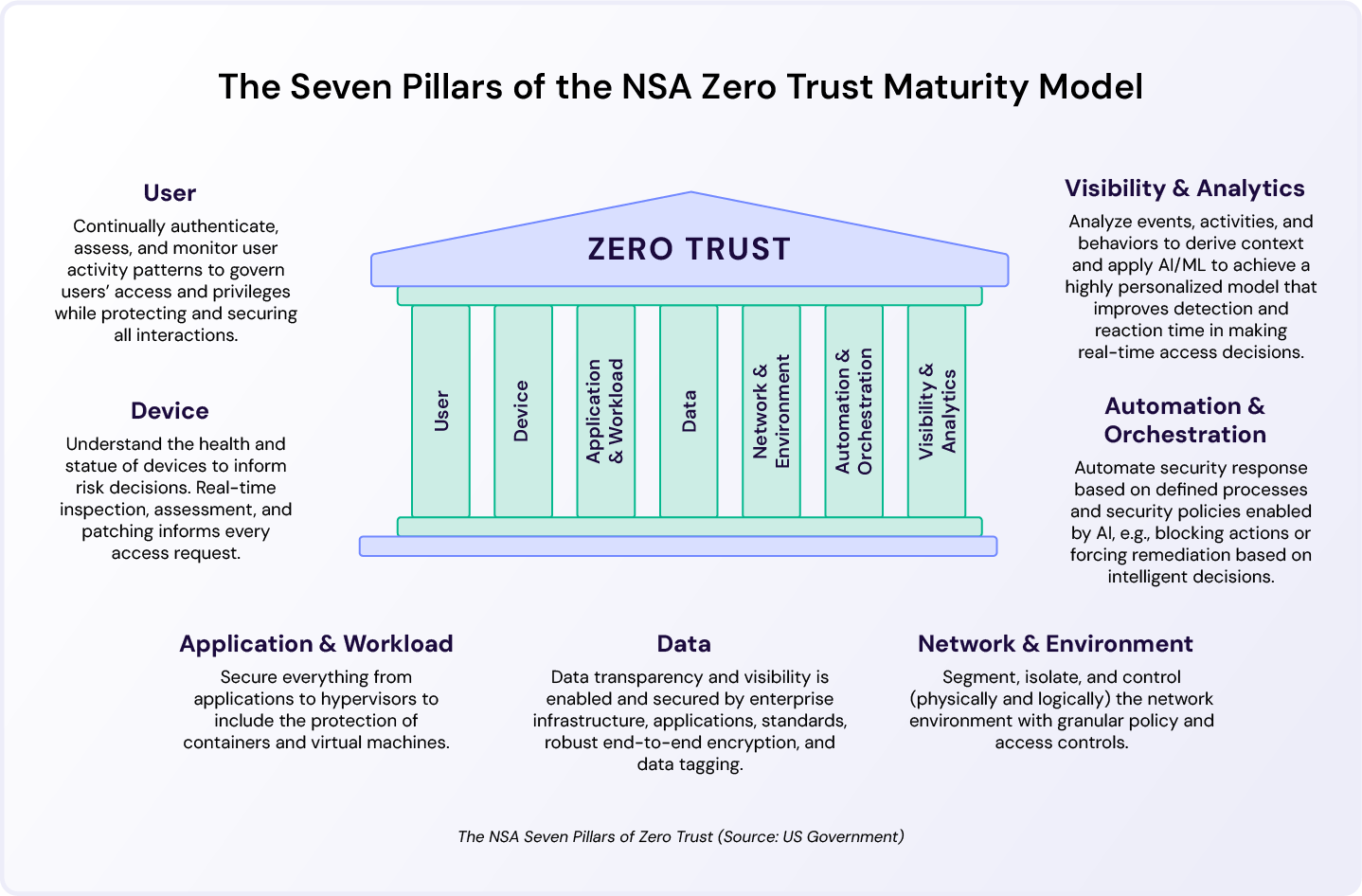
2026 Regulatory Shifts in Zero Trust
As of January 2026, the regulatory landscape for zero trust architecture has shifted from conceptual guidance to operational mandate. The National Security Agency (NSA) released its Zero Trust Implementation Guideline Primer, marking a definitive move toward enforced compliance. This document, alongside updated references to NIST SP 800-207, signals that zero trust is no longer optional for federal and critical infrastructure sectors.
The agency’s January 2026 guidelines emphasize continuous verification over static perimeter defense. The primer clarifies that organizations must treat all network traffic as hostile, requiring identity-based access controls and micro-segmentation. This aligns with the core NIST principle that network location is no longer a trusted indicator of safety.
For legal and compliance teams, these updates establish clear audit expectations. The focus is now on demonstrable implementation of continuous monitoring and validation. Organizations must be prepared to show evidence of policy enforcement rather than just architectural design.
The integration of NIST SP 800-207 principles into these NSA guidelines creates a unified standard. Compliance now requires adherence to specific technical controls outlined in the primer, including strict identity management and least-privilege access models.
Micro-segmentation for enterprise subnets
Micro-segmentation operates as the technical backbone of zero trust architecture, shifting security controls from the network perimeter to individual workloads. In January 2026, both the National Institute of Standards and Technology (NIST) and the National Security Agency (NSA) emphasized that traditional boundary defenses are insufficient for modern enterprise environments. By isolating traffic at the workload level, organizations enforce least-privilege access regardless of the user's location or the network's physical topology.
This approach ensures that identity-based policies follow the workload across on-premises, private cloud, and public cloud environments. Security teams can apply granular access controls to specific application components, preventing lateral movement even if an attacker breaches the initial entry point. The agency’s guidelines highlight that this segmentation is critical for maintaining resilience against sophisticated threats that exploit trust relationships within internal networks.
The following comparison illustrates the operational differences between legacy perimeter models and the micro-segmentation strategies recommended in current regulatory frameworks.
Identity verification and continuous monitoring
The January 2026 guidelines from NIST and the NSA mark a definitive shift from perimeter-based security to identity-first access. In this framework, network location is no longer a valid trust indicator. Access decisions are driven by verified identity, device health, and contextual risk signals rather than IP address or physical proximity to the corporate network.
1. Enforce strict identity verification
Organizations must implement multi-factor authentication (MFA) for all users and services. The agency emphasizes that static credentials are insufficient for zero trust compliance. Identity providers must validate user and machine identities before granting access to any resource, ensuring that only authorized entities can initiate connections.
2. Validate device and application health
Verification extends beyond the user to the endpoint and application layer. Systems must continuously assess device posture, checking for patch levels, encryption status, and malware presence. Access is granted only when the device meets the specific security policies defined for the requested resource.
3. Implement continuous monitoring and validation
Trust is not a one-time event. The NIST guidelines require continuous monitoring of all access sessions. If a user’s behavior or device status changes—such as a sudden spike in data transfer or a detected vulnerability—the system must re-evaluate the risk and potentially revoke access immediately.
4. Log and audit all access events
Comprehensive logging is essential for post-incident analysis and regulatory compliance. Every authentication attempt, access grant, and policy decision must be recorded. These logs provide the necessary visibility to detect anomalies and demonstrate adherence to zero trust principles during audits.
These operational requirements ensure that security measures remain effective and up-to-date, enabling the detection of threats in real-time. By adhering to these January 2026 standards, organizations can build a resilient architecture that prioritizes verification over implicit trust.
Compliance requirements for 2026
By January 2026, the regulatory landscape for Zero Trust Architecture shifts from voluntary best practices to mandatory compliance frameworks. The National Institute of Standards and Technology (NIST) and the National Security Agency (NSA) have released updated guidelines that require enterprises to demonstrate rigorous adherence to specific technical controls. These regulations apply to federal contractors, critical infrastructure operators, and organizations handling sensitive data, establishing a baseline for audit gate compliance.
Audit trails and data protection remain the primary focus of these new requirements. NIST SP 800-207 revisions emphasize that security must protect resources—such as assets, services, and workflows—rather than relying on network segments. Consequently, compliance audits now verify that every access request is continuously authenticated and authorized, regardless of the user's location. Organizations must maintain immutable logs of all access attempts and policy decisions to satisfy regulatory scrutiny.
The distinction between voluntary best practices and mandatory regulatory requirements is critical for high-stakes sectors. Failure to align with NIST and NSA guidelines by the 2026 deadline may result in loss of federal contracts or penalties for critical infrastructure operators.
The agency’s 2026 guidelines further clarify that "no users or devices are safe" and must always be verified. This principle mandates strict identity governance and least-privilege access models. Enterprises must document their implementation strategies, showing how they have eliminated implicit trust in network boundaries. Compliance is no longer just about having tools; it is about proving that those tools enforce continuous verification across the entire digital estate.
Frequently asked questions about zero trust
What is the specific deadline for NIST SP 800-207 compliance in 2026?
The January 2026 guidelines establish a hard transition from voluntary adoption to mandatory compliance for federal agencies and their contractors. Organizations must demonstrate operational readiness by this date, moving beyond architectural design to evidence of enforced policy execution.
How does the NSA's January 2026 primer differ from previous NIST guidance?
While NIST SP 800-207 provides the foundational architecture, the NSA's 2026 primer adds operational mandates for continuous verification and micro-segmentation. It explicitly treats all internal traffic as hostile, requiring stricter identity governance than previous perimeter-focused models.
What are the consequences of non-compliance with the 2026 regulations?
Failure to align with these guidelines by the 2026 deadline may result in the loss of federal contracts for contractors and significant penalties for critical infrastructure operators. Audits will now verify continuous authentication rather than static security configurations.
No comments yet. Be the first to share your thoughts!